
EN 10305-1 and ASTM A519 both cover seamless steel tubing, but they are not interchangeable purchasing specifications. EN 10305-1 is focused on seamless cold-drawn tubes for precision applications. ASTM A519 covers multiple grades of seamless carbon and alloy mechanical tubing supplied hot-finished or cold-finished and includes round, square, rectangular and special shapes.
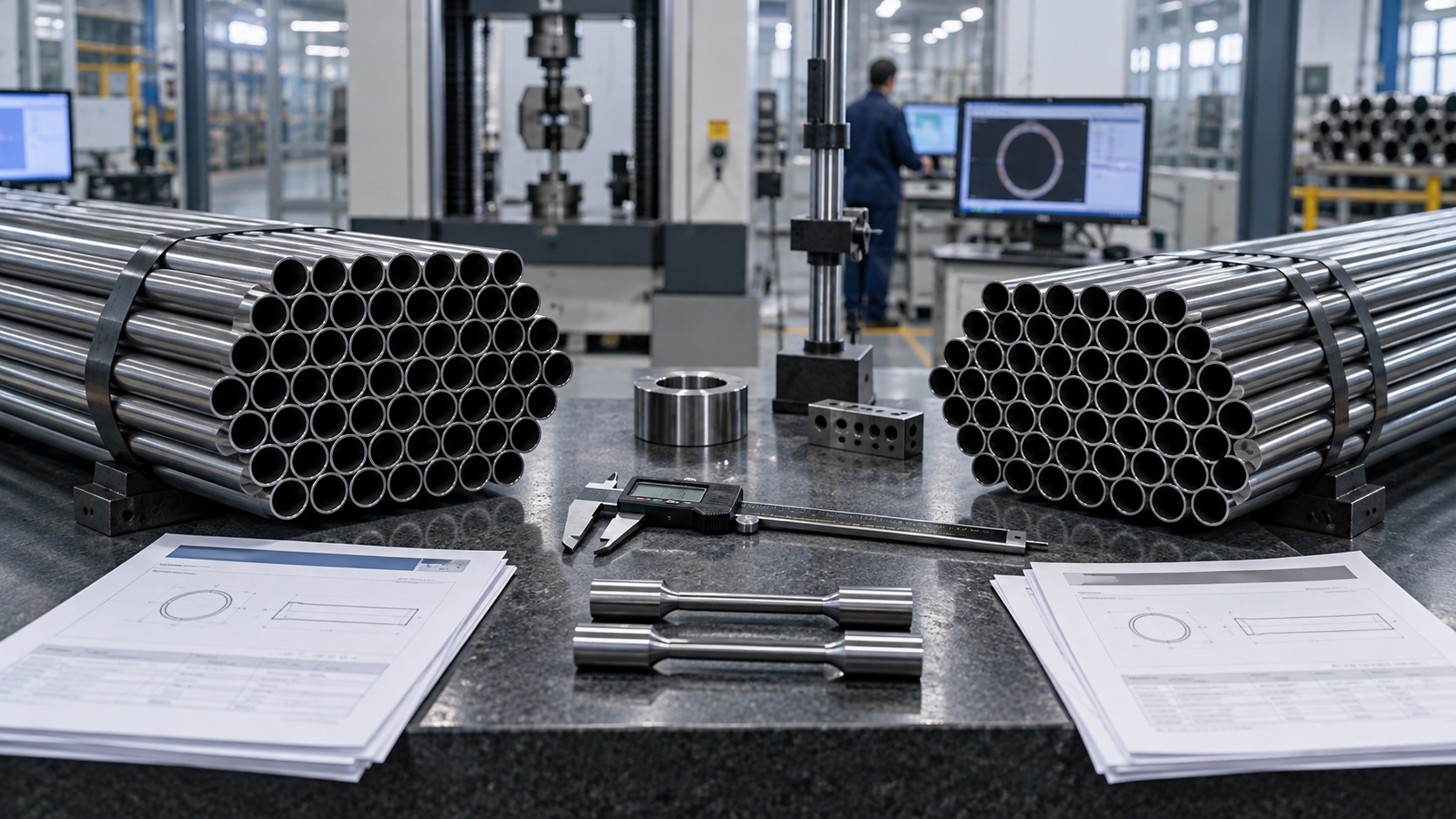
The right choice depends on the drawing, target market, grade system, dimensional strategy, delivery condition and inspection requirements. New Star Steel’s Precision Steel Tube range can be specified under either system when the requested size and condition are feasible.
BSI’s EN 10305-1 overview describes seamless cold-drawn tubes of circular cross-section for precision applications, with applicability to other cross-sections. It emphasizes defined dimensional tolerances and maximum surface roughness.
ASTM’s A519/A519M scope covers seamless carbon and alloy steel mechanical tubing, hot-finished or cold-finished. ASTM explicitly includes round, square, rectangular and special sections.
| Topic | EN 10305-1 | ASTM A519/A519M |
|---|---|---|
| Primary product focus | Seamless cold-drawn precision tube | Seamless carbon/alloy mechanical tubing |
| Common grade language | E-series grades such as E355 | SAE/AISI-style carbon and alloy grades such as 1026 |
| Finish route | Cold drawn within the stated scope | Hot finished or cold finished |
| Shapes | Primarily circular; may apply to others | Round, square, rectangular and special sections |
| Units | Metric European system | Inch-pound or SI when the “M” designation is used |
| Ordering emphasis | Grade, delivery condition, dimensions, options and inspection | Grade, manufacture/condition, dimensions and supplementary requirements |
E355 and SAE 1026 are frequently discussed as alternatives, but they identify steel under different systems. Mechanical properties depend on the finished-tube condition, while chemistry limits and testing rules come from different documents. A valid comparison checks the exact edition, size, condition and required test results.
Our E355, ST52 and SAE 1026 guide provides a structured equivalence-review method.
Precision applications often need a defined control route: OD and wall, ID and wall, or OD and ID. The order should clarify which dimension is controlling and how heat treatment affects tolerances. If machining follows, state the minimum usable stock allowance instead of applying the tightest catalog tolerance to every feature.
Review straightness, ovality, surface condition, permissible imperfections and end finish. The practical checklist in our precision steel tube tolerances guide helps convert design intent into measurable RFQ clauses.
Specify the required inspection document and any chemical, tensile, hardness, flattening, flaring, NDT or dimensional reporting needed by the contract. Do not assume that a certificate format automatically adds tests; the tests must be required by the product standard, an invoked option or the purchase order.
DIN 2391 remains visible on older drawings and in buyer search terms. For new European procurement, review the current EN 10305 series and document the transition. DIN Media lists DIN EN 10305-1:2016-08 as the current German adoption for seamless cold-drawn precision tubes. Legacy requirements should be mapped clause by clause rather than replaced by name alone.
Neither is universally better. The design may use EN precision-tube grades or ASTM mechanical-tube grades. Finished bore and seal-surface requirements must usually be added to either base-tube specification.
Yes. ASTM’s scope includes square, rectangular and special sections as well as round tube. Confirm available size, process route and final tolerances with the producer.
Sometimes, if chemistry, mechanical properties, manufacture, dimensions, tests and documentation satisfy both standards. Dual certification must be reviewed before production and stated on the order.
To compare an EN and ASTM drawing for sourcing, send New Star Steel the complete specification, size range, quantity and destination.