
E355, ST52 and SAE 1026 are not interchangeable labels. E355 belongs to a European product-standard system with mechanical-property and delivery-condition requirements; SAE 1026 is primarily a carbon-steel chemistry designation used with a separate product specification; ST52 is common legacy terminology whose exact meaning depends on the historical document and drawing context.
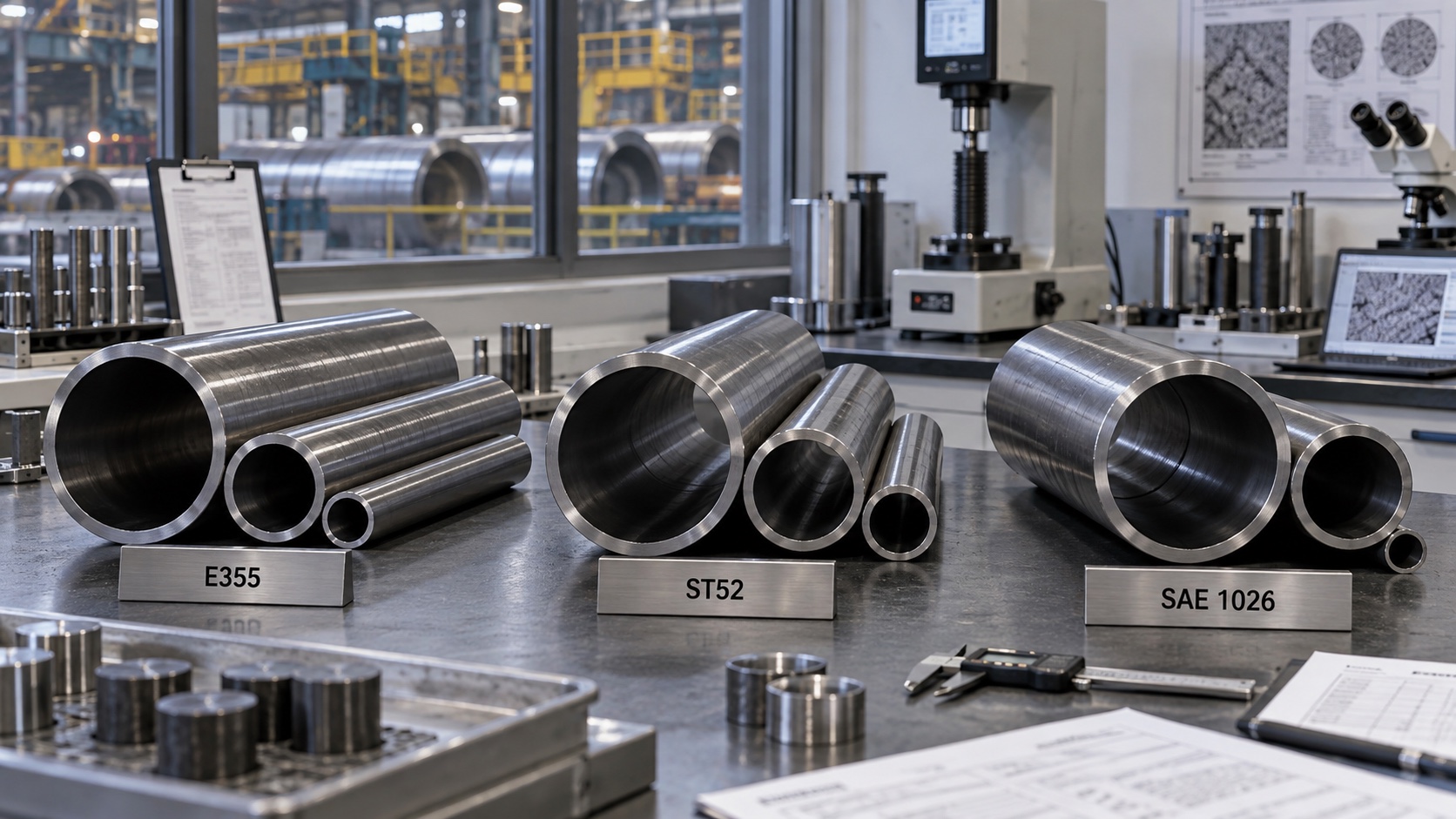
For a reliable quotation, state both the steel designation and the governing tube standard. New Star Steel’s Hydraulic Cylinder Tube team can review legacy and current drawings before material is confirmed.
Global cylinder manufacturers inherit drawings from different regions and decades. A European drawing may call for E355 under EN 10305, an older drawing may say ST52, and a North American bill of materials may specify ASTM A519 with SAE 1026. Because all three requests can describe medium-strength carbon-steel tubing, commercial conversations sometimes call them “equivalent.” That shortcut is risky.
Strength depends on more than chemistry. Cold drawing, normalizing, stress relieving and other delivery conditions change mechanical properties. Dimensional tolerances, inspection rules and test certificates come from the product standard, not the grade name alone.
| Designation | What it primarily identifies | Buyer must also define |
|---|---|---|
| E355 | A steel grade used in the EN 10305 precision-tube family | Applicable part, delivery condition, dimensions, options and inspection document |
| ST52 | Legacy German-style designation used in older specifications and trade language | Original standard/edition, intended properties and proposed current replacement |
| SAE 1026 | A carbon-steel chemistry designation maintained in the SAE system | Product standard such as ASTM A519, condition, mechanical requirements and tube dimensions |
BSI describes EN 10305-1 as covering seamless cold-drawn tubes for precision applications, characterized by defined dimensional tolerances and specified maximum surface roughness. E355 orders may be supplied in different delivery conditions, and the required mechanical properties are linked to that condition. Never quote an E355 strength value without identifying the relevant product standard and condition.
For cold-drawn seamless precision tube, see New Star Steel’s Precision Steel Tube range and our EN 10305-1 vs ASTM A519 guide.
ST52 should trigger a document review, not an automatic substitution. Ask for the complete original standard number, issue date, heat-treatment condition, required yield and tensile properties, impact requirements if any, and intended service. Then prepare a documented comparison to the proposed current grade.
The customer, designer or responsible engineer should approve the substitution. Put that approval and the final acceptance requirements on the order so that mill testing is tied to an agreed basis.
SAE J403 defines chemical compositions for SAE carbon steels. ASTM A519/A519M covers seamless carbon and alloy steel mechanical tubing in hot-finished or cold-finished form. A robust North American order therefore states the ASTM product specification, grade, size, condition and supplementary requirements rather than “1026 tube” alone.
No blanket statement is safe. ST52 is used as a legacy commercial reference, while E355 is specified within current EN product standards. Compare the exact documents, conditions and properties.
The question cannot be answered from grade names alone. SAE 1026 identifies chemistry; E355 requirements depend on the EN product standard and delivery condition. Finished-tube test results must be compared.
Specify the inspection document required by your contract and market, commonly an EN 10204 type 3.1 certificate for traceable material data when appropriate. Also define any dimensional or roughness report separately.
Need help translating a legacy tube specification into a purchase order? Send the drawing to New Star Steel with the application, quantity and destination market.