
Choose zero or minimized spangle when you need a smooth, uniform appearance for painting, appliances, ductwork or visible fabrication; choose regular spangle when the crystalline zinc pattern is acceptable or intentionally decorative. Spangle size is mainly an appearance and processing variable—it does not, by itself, define zinc coating mass or corrosion life.
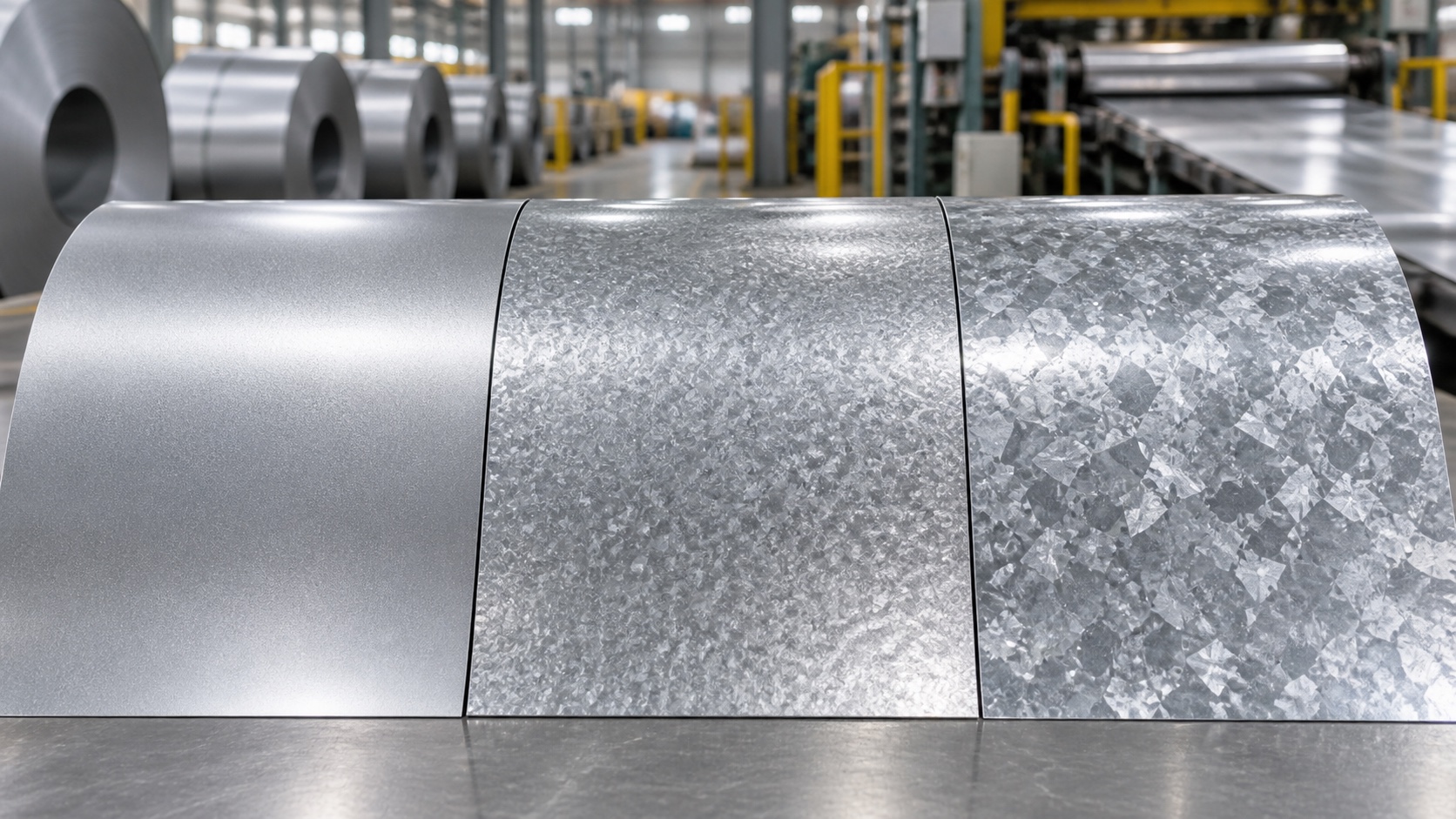
New Star Steel’s Galvanized Steel Coil can be quoted with coating designation, surface quality, spangle, passivation and oiling stated separately.
Spangle is the visible crystal pattern that forms as molten zinc solidifies on steel after hot-dip coating. Chemistry, bath control, cooling rate, substrate and post-treatment influence the final appearance. Modern production can suppress visible crystal growth to create a nearly uniform zero-spangle surface.
GalvInfo’s technical note explains the historical role of spangle and the metallurgical factors that affect it.
| Surface | Appearance | Typical buyer priority |
|---|---|---|
| Zero/non-spangle | Uniform, little visible crystal pattern | Painted panels, appliances, exposed ducting, consistent cosmetics |
| Minimized/small spangle | Fine, subdued crystal pattern | General fabrication needing a controlled metallic appearance |
| Regular spangle | Clearly visible zinc crystals | Non-painted work, traditional galvanized appearance, noncritical cosmetics |
Coating mass, coating continuity, environment and fabrication damage are more important corrosion variables than crystal size. A zero-spangle Z275 coil and a regular-spangle Z275 coil are ordered to the same nominal coating-mass class when all other requirements are equal.
Spangle should therefore never replace the coating designation on an RFQ. For coating-mass terminology, read What Does Z275 Mean?
Zero or minimized spangle is generally preferred when the final surface must appear uniform under paint. Skin passing can further control flatness and texture. However, paint adhesion depends on pretreatment, cleanliness, passivation compatibility, oil removal and coating system—not on spangle alone.
Tell the steel supplier whether the coil will be powder coated, wet painted, laminated or left bare. Confirm the chemical treatment is compatible with the downstream line.
For bends and draws, the base-steel grade, thickness, coating mass, surface treatment and tooling dominate formability. Spangle choice is not a substitute for selecting the proper forming grade. Use production-intent samples for validation, especially on visible panels where stretcher strain, scratches or roll marks are unacceptable.
Spangle is one line in a complete specification. A DX51D or SGCC order still needs coating mass, dimensions, tolerances, coil data and test documentation. Compare the two systems in DX51D vs SGCC Galvanized Steel Coil.
Price depends on mill route, coating, surface class, order volume and market availability. Do not assume a fixed premium; request both options against the same specification.
Yes, with suitable cleaning and pretreatment, but the crystal pattern or surface variation may remain visible under some paint systems.
Not automatically. It can be a deliberate appearance. It becomes nonconforming only when the order requires another surface or the sheet fails applicable coating and surface criteria.
To approve a visual sample or request coil pricing, contact New Star Steel with the end use, surface, coating, dimensions and monthly volume.