
DX51D and SGCC are widely used commercial-quality hot-dip galvanized steel designations, but they come from different standards systems. DX51D is associated with EN 10346, while SGCC is associated with JIS G 3302. Buyers should not approve substitution from the grade names alone; coating mass, base-metal properties, surface quality, treatment, dimensions and intended forming operation must also match.
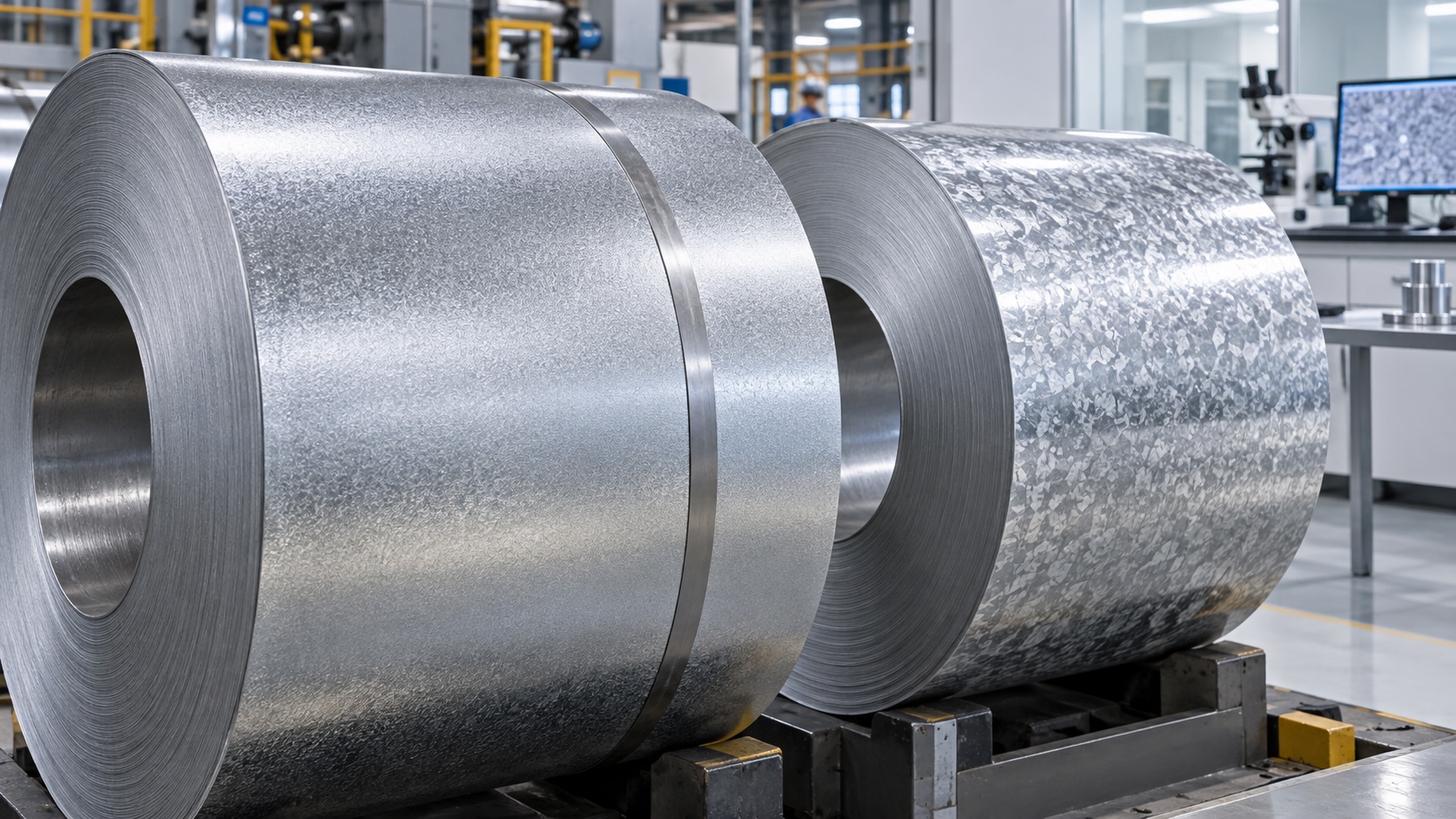
New Star Steel supplies Galvanized Steel Coil for fabrication, roofing, ductwork, appliances and general manufacturing, subject to the agreed specification.
EN 10346 covers continuously hot-dip coated flat products and uses a designation system that communicates steel type and intended forming behavior. JIS G 3302 uses its own designations, test rules and coating notation. Even when two commercial grades are used for similar components, their chemical limits, mechanical guarantees, surface classifications and inspection language may not align line by line.
BSI’s EN 10346 overview notes that the standard covers several metallic coating systems and products selected for formability, strength and corrosion resistance.
| Topic | DX51D | SGCC |
|---|---|---|
| Standard system | European EN 10346 | Japanese JIS G 3302 |
| Common use | General forming and fabrication | Commercial-quality general fabrication |
| Coating | Must be stated separately, e.g. zinc coating designation | Must be stated using the applicable JIS coating designation |
| Surface/finish | Surface quality, spangle and treatment are order items | Finish and treatment follow JIS/order agreement |
| Substitution | Requires a documented requirement-by-requirement comparison | |
The base-steel designation does not tell you how much zinc is present. State total coating mass, test basis and any single-side requirement. In the EN/ASTM SI language, Z275 refers to a minimum total coating mass across both sides under the specified test method. Learn the details in What Does Z275 Mean?
Heavier zinc coatings generally provide a larger corrosion reserve, but they can affect forming, welding, appearance and cost. Coating selection must consider environment, design life, fabrication and any paint system.
“General forming” is not a complete application description. Share the bend radius, draw depth, forming direction, tooling, lubrication and cosmetic requirement. Parts with severe drawing may require a grade designed for deeper forming rather than either general commercial designation.
Prototype with production-intent thickness and coating. A successful test on thin, lightly coated material does not automatically qualify a thicker or heavier-coated coil.
Specify zero, minimized or regular spangle when appearance matters; also state skin-pass requirements, chromate/passivation preference, oiling and paintability. These variables influence fingerprint resistance, storage behavior, adhesion and cosmetic uniformity.
See zero spangle vs regular spangle galvanized steel for a buyer-focused surface guide.
They are often used for similar general-fabrication work, but they are not automatically equivalent. Compare the current standards and every functional order requirement.
That identifies important elements, but a complete order should also state dimensions, tolerances, surface quality, spangle, treatment, oiling, coil data, testing and packaging.
Paint performance depends on surface cleanliness, pretreatment, passivation compatibility, spangle/skin pass and the paint system. Ask the coater and paint supplier to approve the full stack.
For a standards comparison and coil quotation, contact New Star Steel with the finished-part application and destination market.