
Seamless square tube is manufactured from a seamless hollow and shaped to a square or rectangle without a longitudinal weld seam; welded SHS/RHS/HSS is formed from strip or plate and joined along a seam. Seamless construction can be valuable for specialized mechanical, pressure-related or heavy-wall applications, while welded structural hollow section is usually the more available and economical choice for buildings and general fabrication.
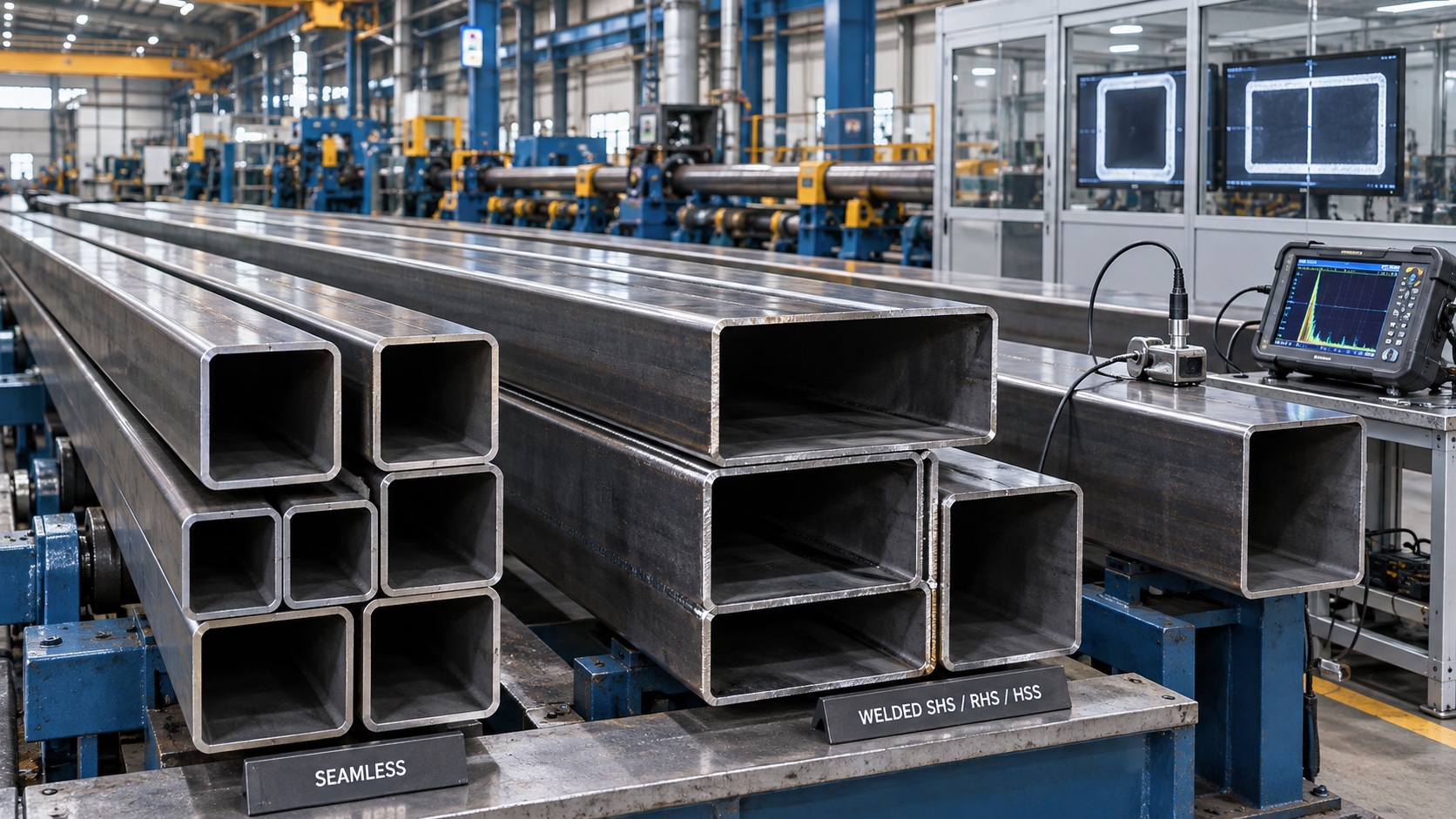
New Star Steel supplies Square Tube and can review seamless versus welded requirements against the application and governing code.
These terms describe section geometry or structural product type, not the absence of a weld. Always add “seamless” when a seam-free product is mandatory.
Seamless tube begins with a pierced solid billet that is rolled into a round hollow. It can then be hot or cold formed into square or rectangular geometry. Welded tube starts with flat strip or plate, is formed to shape, and its edges are joined—commonly by electric resistance welding for high-volume structural sections.
The Steel Construction Information resource describes these two basic routes and notes that square and rectangular hollow sections are shaped through work rolls. Process route influences corner radius, residual stress, wall distribution, size availability and cost.
| Factor | Seamless square/rectangular tube | Welded SHS/RHS/HSS |
|---|---|---|
| Longitudinal seam | None | Present and controlled by the product standard |
| Availability | More specialized; fewer standard sizes | Broad standard structural size range |
| Heavy wall/special mechanical use | Often a strong candidate | Available within standard and mill limits |
| Structural economy | Usually higher cost | Usually more economical |
| Corner and wall control | Depends on shaping route and reduction | Depends on forming process and standard tolerances |
| Code acceptance | Must be verified against the governing design/product standard | |
ASTM A500/A500M covers cold-formed welded and seamless carbon-steel structural tubing in round and shaped sections for buildings, bridges and general structural purposes. Therefore, saying “ASTM A500 square tube” does not identify the manufacturing route; welded or seamless should be stated if the distinction matters.
ASTM A519 is another possible reference for seamless mechanical tubing and explicitly includes square, rectangular and special shapes. The correct specification depends on whether the component is structural or mechanical and on the required properties and inspection.
The EN 10210 family addresses hot-finished structural hollow sections, while EN 10219 addresses cold-formed welded structural hollow sections. Section properties, tolerances and design assumptions are tied to the relevant family. Do not substitute hot-finished and cold-formed sections without checking the structural design implications.
Seamless does not automatically mean defect-free or superior for every application. It must still meet chemistry, mechanical properties, dimensions, corner geometry, surface quality and NDT requirements.
No. Some structural standards cover both welded and seamless hollow sections. The common commercial product is often welded, so state the required route.
Not by definition. Design strength is established by grade, finished-section properties, standard, geometry and code rules—not by the word seamless alone.
Yes. Square and rectangular seamless sections are typically produced by shaping a round seamless hollow, with process controls for walls, corners, twist and dimensions.
For a feasibility and cost comparison, send New Star Steel the drawing, standard, load/application, quantity and required delivery schedule.